













ADA-Compliant Signs for Milwaukee Businesses
VIEW GALLERYADA-compliant signage isn’t optional — for most commercial spaces, the Americans with Disabilities Act requires specific signs in specific locations, with specific tactile, Braille, and contrast standards. Milwaukee Sign Company designs, fabricates, and installs ADA-compliant signs for offices, clinics, retail spaces, multi-tenant buildings, schools, and public facilities across Greater Milwaukee — all built to meet ADA Title III requirements and Wisconsin building code.
What Makes a Sign “ADA-Compliant”?
Under the 2010 ADA Standards for Accessible Design, signs identifying permanent rooms and spaces in public-accommodation buildings must meet a set of requirements that go beyond just “having a sign.” The major rules include:
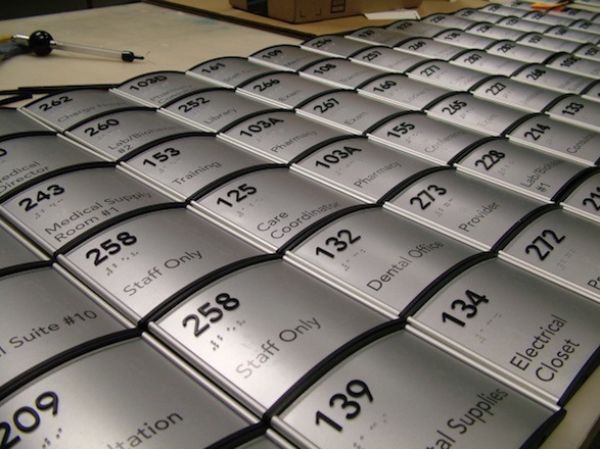
- Tactile (raised) characters. Letters and numbers must be raised from the sign surface by 1/32 inch minimum, in sans-serif uppercase, between 5/8 inch and 2 inches tall.
- Grade 2 Braille. Below the tactile text, contracted (Grade 2) Braille is required for room identifiers — not just dot patterns alone.
- Non-glare finish. Both the background and the characters must use a non-glare finish to remain readable from multiple angles.
- High contrast. Light characters on a dark background, or dark characters on a light background — minimum 70% contrast.
- Specific mounting location. Signs must be mounted on the latch side of the door, with the baseline of the lowest tactile character between 48 and 60 inches above the floor, and clear floor space in front of the sign.
- Pictograms. When pictograms are used (restrooms, accessibility, etc.), the field must be at least 6 inches tall, and tactile/Braille text appears below.
These rules apply to most signs that identify a permanent space — restrooms, exit doors, room numbers, stairwells, conference rooms, and so on. Directional and informational signs have a separate (looser) set of rules around character size and contrast but don’t require Braille or tactile elements.
Where ADA Signs Are Required
In any public-accommodation or commercial space subject to ADA Title III, the following spaces typically need ADA-compliant signage:
- Restrooms — including pictogram, room ID, and Braille
- Permanent room identifiers — offices, conference rooms, treatment rooms
- Exit signs — interior tactile exit signs (separate from emergency illuminated exit signs)
- Elevator floor designators — on jambs and inside cars
- Stairwell identifiers — floor levels and exit information
- Parking signage — accessible spaces, van-accessible designations
- Wayfinding signage — directional signs to accessible entrances, restrooms, and elevators (require character-size and contrast compliance, not necessarily tactile/Braille)
Buildings opened or significantly remodeled after January 26, 1992 fall under the federal ADA. Wisconsin commercial code generally aligns with federal ADA requirements but adds permitting and inspection requirements at the municipal level.
Common ADA Compliance Failures We See
When we get called in to retrofit signage that failed an inspection, the issues are almost always one of these:
- Wrong Braille type. Grade 1 (uncontracted) Braille was used instead of Grade 2 (contracted). Grade 1 doesn’t meet ADA.
- Glossy finish. A sign that looks beautiful in product photos reflects glare from overhead lighting and becomes unreadable from certain angles. ADA requires matte or eggshell finish on both background and characters.
- Insufficient tactile depth. Vinyl letters applied to a flat sign aren’t tactile. Characters must be raised at least 1/32 inch — usually achieved through routing, photopolymer, or 3D-printed methods.
- Wrong mounting height or side. The sign must be on the latch (handle) side of the door at 48–60 inches to the lowest character baseline. Mounting on the hinge side or above 60 inches fails inspection.
- Pictograms with text inside the field. Pictogram fields must be plain — text, Braille, or other elements go below the field, not within it.
- Custom fonts. Some decorative or serif fonts don’t meet ADA character-shape requirements. Sans-serif uppercase Helvetica, Arial, or similar are safe choices.
We often see good-looking signs that were custom-printed by a non-specialist shop and passed visual inspection but failed an actual ADA review. Catching these issues at design time saves rework cost.
Our ADA Signage Process
- Site assessment. We walk the space (or work from drawings) to identify every door, room, and signage location that requires an ADA sign.
- Code review. We cross-check ADA Title III requirements against your local Wisconsin municipal code, since some cities have additional requirements layered on top.
- Design. Tactile characters routed or photopolymer-built, Grade 2 Braille, ADA-compliant fonts and contrast ratios, finishes that meet glare requirements.
- Material selection. Acetate, photopolymer, brushed aluminum, painted MDO, and other materials each have ADA-suitable applications. We select based on environment (interior vs. exterior, wet locations, durability requirements).
- Fabrication. Built in our Sussex workshop with the same quality control as the rest of our signage work.
- Installation. Our crew installs to ADA mounting specifications (height, location, mounting hardware that doesn’t violate Braille readability).
- Documentation. We provide an ADA compliance summary you can share with inspectors.
Industries We Serve for ADA Signage
- Medical and dental offices — full restroom + room ID sign packages
- Multi-tenant office buildings — building directories, suite numbers, restrooms
- Retail and storefronts — restroom and accessibility signage
- Schools and educational facilities — room IDs, wayfinding, exit signs
- Healthcare facilities and clinics — full ADA packages tied to patient flow
- Manufacturing and warehousing — office areas, restrooms, common spaces
- Hospitality — guest-room IDs, conference space, common areas
- Religious institutions — meeting rooms, offices, restrooms
If you’re opening or remodeling a space in Greater Milwaukee, ADA signage should be part of the build-out budget from day one. Adding it later as a punch-list item usually costs more.
Frequently Asked Questions
Are all signs in my building required to be ADA-compliant?
No. ADA tactile/Braille requirements apply specifically to signs identifying permanent rooms and spaces. Directional and informational signs have separate (less strict) rules about character size and contrast. Decorative signs, marketing graphics, and temporary signage are generally exempt — but the line can be blurry, so a site assessment is the safest way to identify what needs to comply.
How much do ADA signs cost?
ADA signs typically run between $25 and $250 per sign depending on size, material, and complexity. A standard restroom sign with pictogram and Braille is on the lower end; a custom corporate-branded ADA package with custom finishes is higher. We provide itemized quotes after a site assessment.
Can I add Braille to existing signs to make them ADA-compliant?
In most cases, no. ADA requires the tactile characters and Braille to be integrated into the sign — typically through routing, photopolymer, or appliqué methods that meet specific dimensional and finish standards. Adding stick-on Braille labels to an existing flat sign almost never passes inspection.
What happens if my signs aren’t ADA-compliant?
Risks include: failed building-code inspection (which can hold up a Certificate of Occupancy), ADA-related civil complaints (which can carry significant settlement costs), and accessibility lawsuits (which have become more common across Wisconsin). The cost of compliance is almost always lower than the cost of remediation.
Do you handle the permits?
For exterior signs that require a Wisconsin municipal sign permit, yes — we handle the permit application and code review as part of every project. ADA interior signs typically don’t require a separate permit, but they’re inspected as part of the building’s overall accessibility compliance review.
Get an ADA Sign Quote
Send us a quick description of your space — square footage, number of rooms, restrooms, and any drawings you have — and we’ll come back with an ADA signage proposal.
Phone: (262) 372-4030
Workshop: N63 W22625 W Main St #105, Sussex, WI 53089
Hours: Monday–Friday, 8:00 AM – 5:00 PM
Call (262) 372-4030 today or request an ADA sign quote online.