
Pylon Sign vs. Monument Sign: Which Is Best for Your Business?
A pylon sign is a tall freestanding sign designed to be read from farther away and at higher driving speeds. A monument sign is a lower, ground-oriented freestanding sign that emphasizes architectural fit and entrance identification. The right choice depends on road visibility, setback, tenant count, zoning, site design, and the message a driver must understand.
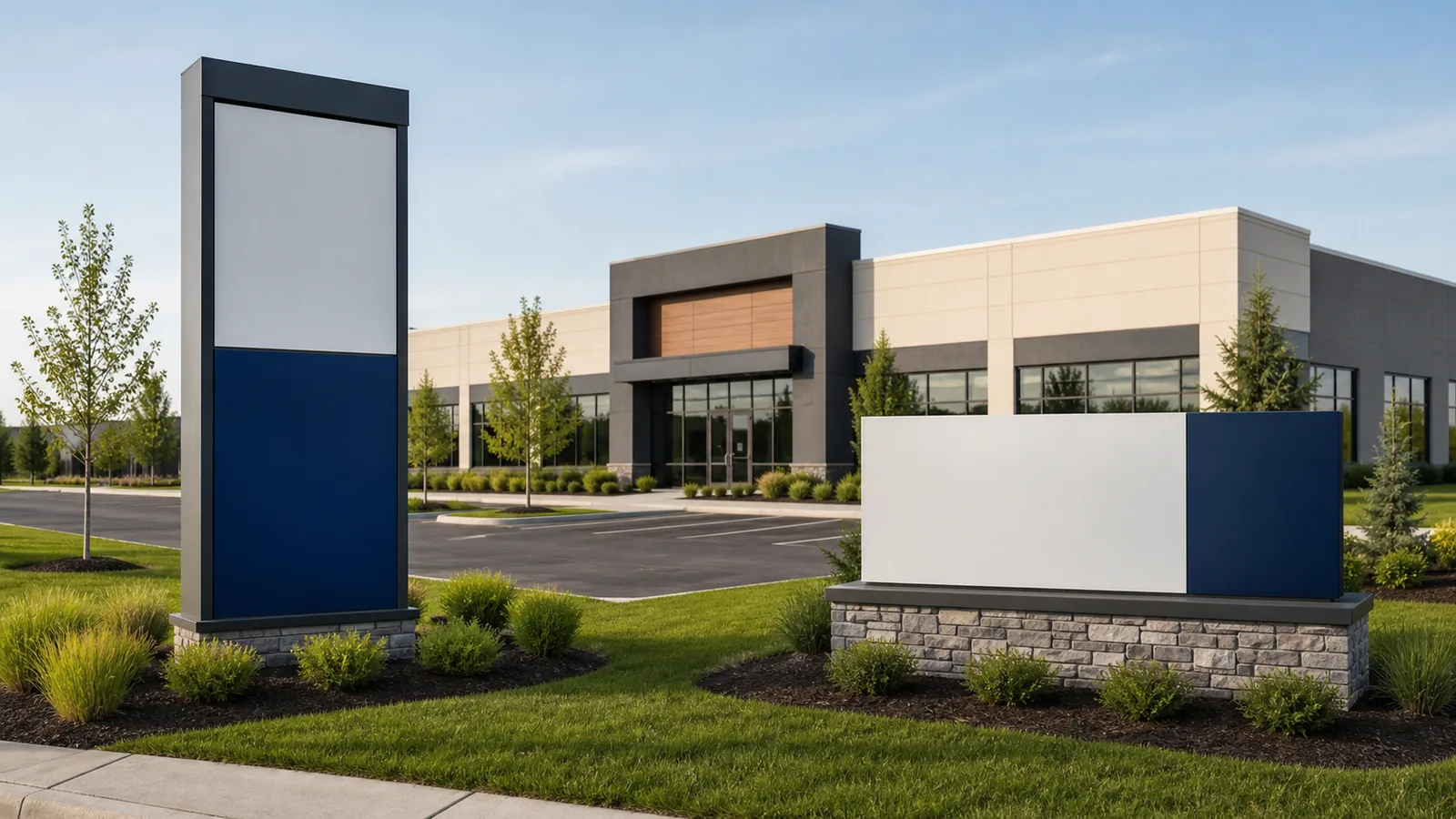
For many Milwaukee-area properties, the pylon sign vs monument sign decision becomes clear after a site survey. If the building sits far from a busy road or competing objects block the view, height may be essential. If drivers already know where to turn and the property needs an attractive entrance marker, a monument is often the better fit.
Pylon sign vs. monument sign: quick comparison
| Decision factor | Pylon sign | Monument sign |
|---|---|---|
| Typical profile | Tall, elevated cabinet or sign faces on one or more structural supports | Low-profile sign integrated with a solid-looking base |
| Best viewing condition | Longer distance, higher traffic speed, deep setback, visual obstructions | Entrance identification, slower traffic, campus or development setting |
| Architectural character | Visibility-first; supports can be exposed or enclosed | Designed to relate closely to the building, landscape, masonry, or site |
| Multi-tenant use | Excellent for listing several businesses from the roadway | Good when the tenant list can remain readable at the available height and width |
| Digital display option | Often suitable when local code permits | Can also incorporate a message center, but available area may be smaller |
| Main cost drivers | Height, structure, engineering, foundations, crane access, cabinet size, illumination | Base construction, masonry or cladding, cabinet, foundation, landscaping, illumination |
| Common planning constraint | Height, sign area, setbacks, spacing, wind load | Sight triangles, landscaping, sign area, height, setback |
“Pylon,” “pole,” “ground,” and “freestanding” are not used identically in every sign code. The International Sign Association glossary is useful for industry terminology, but the local municipality’s definitions control the permit. In Milwaukee, the zoning code and permit reviewers may classify both designs within broader freestanding-sign rules.
What is a pylon sign?
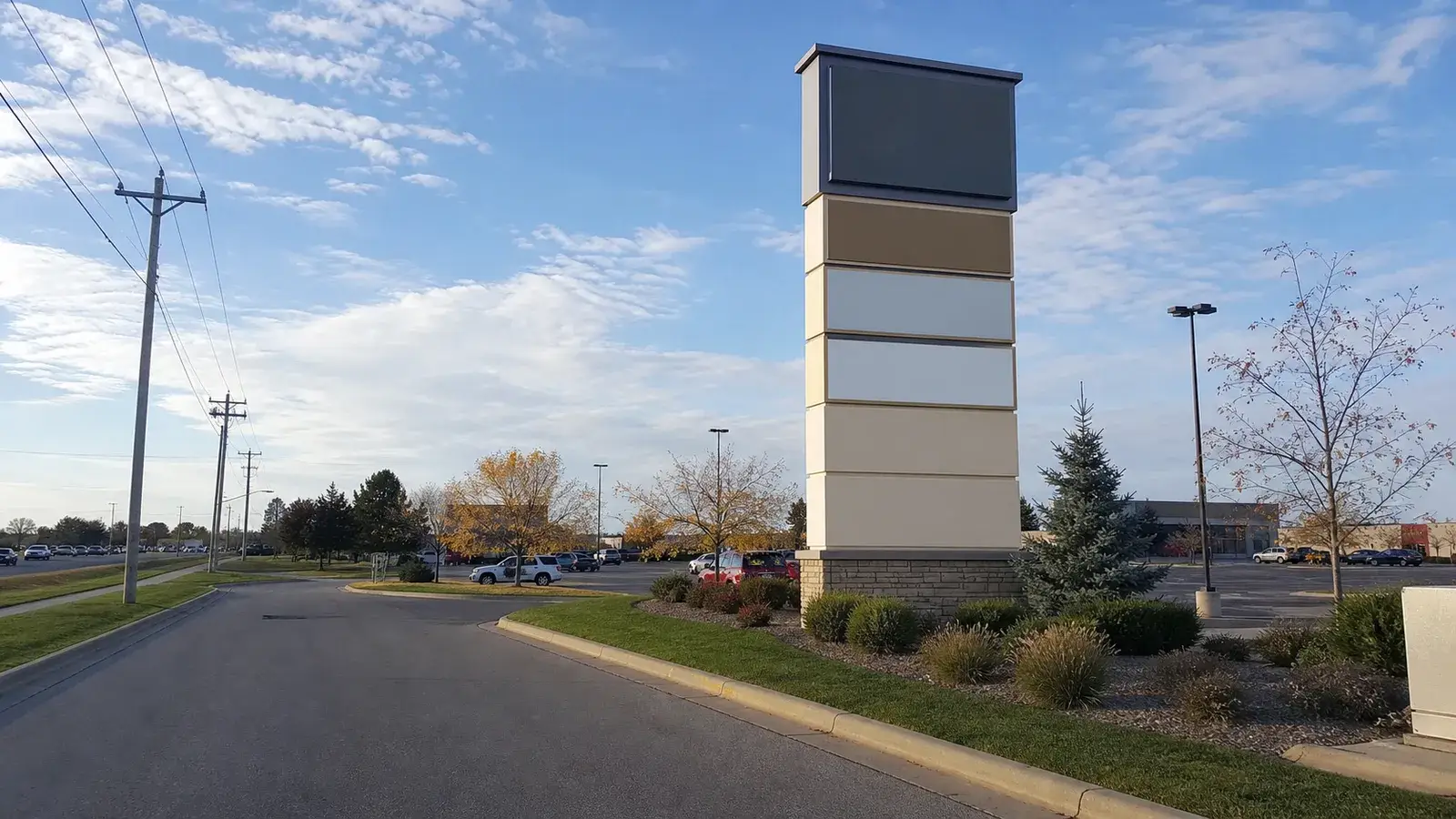
A pylon sign places the display well above grade so it can be seen past parked vehicles, landscaping, nearby buildings, and roadside clutter. The sign face may be mounted on one pole, two poles, or a wider enclosed structure that conceals the supports. It can identify one business, a shopping center, or multiple tenants.
Common pylon-sign components include:
- a steel support structure and engineered concrete foundation;
- one or two sign faces;
- an aluminum cabinet, routed face, dimensional graphics, or illuminated tenant panels;
- internal LED illumination;
- a digital message center when allowed;
- removable tenant panels; and
- service access for lighting and future face changes.
Pylon signs work best when the site needs visibility before a driver reaches the driveway. That makes them common along major commercial roads, at gas stations, auto dealers, shopping centers, hotels, restaurants, and properties set back behind parking.
Explore Milwaukee Sign Company’s pylon and pole sign options for examples of high-visibility freestanding systems.
What is a monument sign?
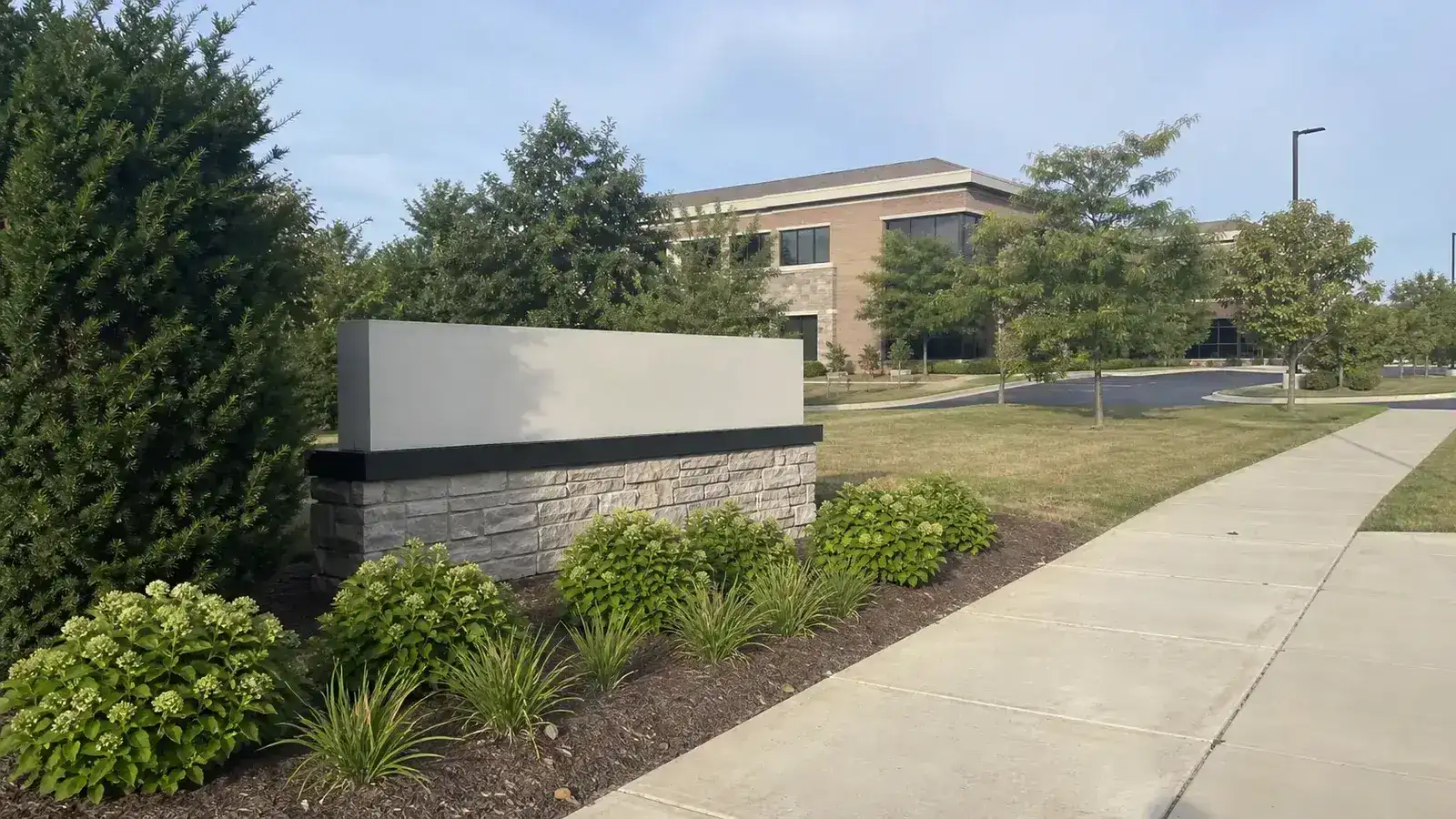
A monument sign sits closer to the ground and usually has a broad, solid visual base. The structure may use aluminum framing with architectural cladding, masonry, stone veneer, brick, stucco-like finishes, routed panels, dimensional letters, or an illuminated cabinet.
Monument signs are common at:
- office and medical campuses;
- schools and religious facilities;
- apartment and condominium entrances;
- industrial parks;
- professional-services buildings;
- planned retail developments; and
- properties where the sign should feel integrated with the landscape.
The lower profile can make a monument sign easier to connect visually with the building. Materials, cap details, colors, and landscaping can repeat architectural elements from the property. That creates a permanent entrance marker rather than a separate roadside object.
See our custom monument sign services for illuminated, multi-tenant, panel, and architectural options.
Which sign is more visible from the road?
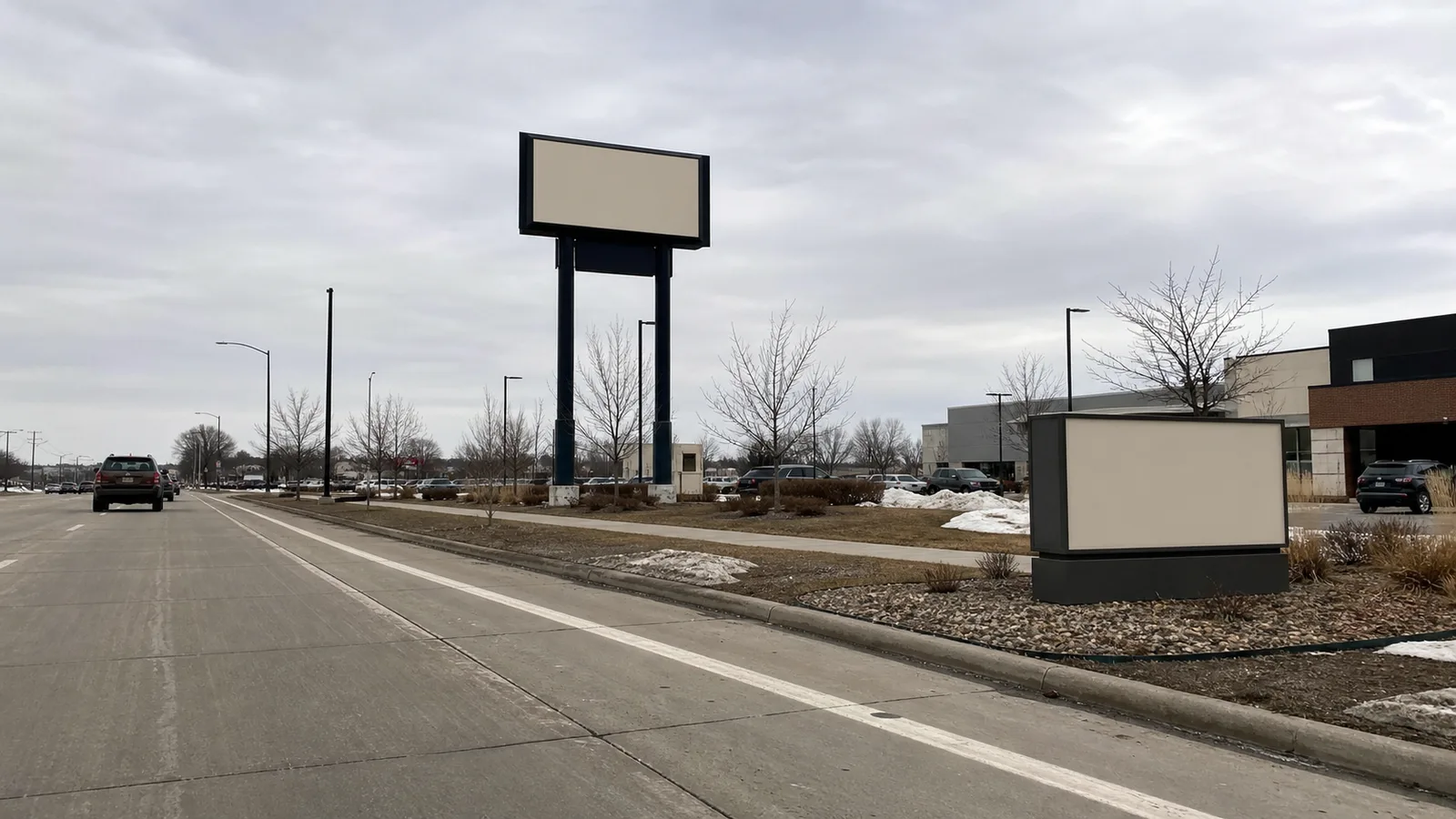
A pylon sign normally wins on long-distance visibility because height can place the message above obstructions. But height alone does not make a sign readable. Letter size, contrast, sign area, message length, illumination, viewing angle, and traffic speed all matter.
A monument sign can be more effective on a lower-speed street where drivers approach the entrance directly. It may also be easier to read when the sign face is close to the driver’s natural sightline and the message is concise.
During a site survey, evaluate:
- Decision distance. How far before the driveway must a driver identify the business?
- Traffic speed. Faster traffic allows less time to see, read, and act.
- Setback. A building or entrance far from the road may need height or a larger face.
- Obstructions. Trees, parked trucks, neighboring signs, grade changes, and utility equipment can block a low sign.
- Approach direction. A sign that works from one lane may disappear from the opposite approach.
- Night conditions. The sign needs adequate contrast and illumination without glare.
Which sign looks better with the property?
Monument signs usually offer more architectural integration. A base can reflect the building’s brick, stone, metal panels, colors, or roofline. Landscaping can frame the sign and guide attention to the entrance.
Pylon signs can also look polished. Enclosing the supports, using proportionate cabinets, organizing tenant panels, and matching the property’s colors can turn a visibility-first structure into a coordinated identity element. The important point is to design the sign as part of the site, not as an oversized logo placed on a pole.
For either type, prioritize a short message and clear hierarchy:
- property or primary brand first;
- major tenant names second;
- address or directional information only when needed; and
- digital or changeable content in a clearly defined area.
Which is better for a multi-tenant property?
Pylon signs are often the stronger choice when many tenants must be visible from a major road. The added height and cabinet area provide more room for organized panels. However, adding more panels does not automatically improve performance. Small tenant names become unreadable when a driver has only a few seconds to look.
A monument sign can serve a multi-tenant office or medical campus well when traffic is slower and the entrance is close to the road. Modular tenant panels make future changes easier without rebuilding the full sign.
Before design, confirm:
- the number of current and planned tenants;
- whether one anchor tenant needs priority;
- who pays for future panel changes;
- whether panels need internal illumination;
- how often tenant turnover occurs; and
- whether the code limits the number, area, or format of tenant names.
What do permits and zoning mean for the decision?
Permits can decide the format before fabrication begins. The City of Milwaukee’s signage-regulations guidance explains that allowable signage depends on sign type, base zoning, and any overlay or special district affecting the property.
The City’s sign-permit information sheet says applicants should be prepared to provide a site plan or survey, sign drawings, support or footing information, and other details needed for zoning and building review. For a ground sign, the drawing should show the full elevation and overall height.
Requirements differ among Milwaukee, Waukesha, Brookfield, Sussex, Menomonee Falls, and neighboring municipalities. Do not assume that an existing sign on another parcel establishes what is allowed on yours. Zoning district, frontage, setbacks, sign area, sight triangles, spacing, illumination, and prior approvals can all change the answer.
A practical sequence is:
- verify the property and zoning district;
- document frontage, setback, grades, utilities, easements, and sightlines;
- identify the locally defined sign type;
- design within the allowable envelope;
- prepare structural and electrical information as required;
- obtain property-owner approval; and
- submit for permit before fabrication.
How do costs differ?
Neither type is automatically cheaper. A small aluminum monument can cost less than a tall engineered pylon, while a large masonry monument with illuminated cabinets and landscaping can cost more than a simple pole sign.
For a pylon sign, cost is driven by:
- structural height and steel;
- engineering;
- excavation and concrete foundation;
- crane and equipment access;
- single- or double-sided cabinets;
- tenant-panel count;
- illumination and electrical service; and
- digital message-center options.
For a monument sign, cost is driven by:
- aluminum versus masonry construction;
- stone, brick, EIFS-style, or metal cladding;
- cabinet and face materials;
- dimensional letters;
- foundation and site restoration;
- illumination;
- tenant-panel systems; and
- landscaping coordination.
The best comparison is a written concept and site-specific estimate, not a generic per-square-foot number. Our broader Wisconsin business sign cost guide explains the factors that affect fabrication, installation, permitting, and electrical work.
A five-question selection checklist
Choose a pylon sign when most answers are yes:
- Must the sign be recognized well before the driveway?
- Is traffic fast or the property deeply set back?
- Do parked vehicles or neighboring objects block a low sign?
- Are there several tenants that need roadway identification?
- Does local code allow enough height and area to solve the visibility problem?
Choose a monument sign when most answers are yes:
- Is the primary job to mark an entrance?
- Is traffic slower or the sign close to the road?
- Should the sign closely match the architecture and landscaping?
- Is a campus, development, or professional-property appearance important?
- Can the message remain readable within the permitted lower profile?
Sometimes the right system uses both: a main roadway pylon for advance identification and smaller monument or directional signs to guide drivers within the property. That decision should come from a wayfinding and code review, not simply a preference for one style.
Frequently asked questions
Is a pylon sign the same as a pole sign?
The terms overlap in everyday use. A pole sign often has visible supports, while a pylon sign may use an enclosure that conceals or decorates the supports. Local zoning definitions may group or separate them, so the municipality’s terminology controls the permit.
Can a monument sign be illuminated?
Yes. Monument signs can use internally illuminated cabinets, halo-lit or face-lit letters, push-through acrylic, external lighting, or a permitted digital display. The design must account for service access, electrical requirements, brightness, and local rules.
Can either sign include a digital message center?
Potentially. Pylon and monument signs can both incorporate electronic message centers when the local code permits them. Brightness, display area, dwell time, animation, and operating rules vary by municipality.
Which sign is better for a shopping center?
A pylon is often better for roadway visibility and multiple tenant names, especially along a fast commercial corridor. A monument may be better where traffic is slower or the development prioritizes an architectural entrance. Site conditions and code decide.
Do I need a permit to replace only the sign face?
Possibly. Rules differ based on whether the cabinet, copy, electrical components, structure, size, or sign type changes. Confirm the scope with the local permit authority before ordering replacement faces.
Get a site-specific recommendation
Milwaukee Sign Company can compare sightlines, sign types, materials, illumination, tenant needs, and the permit path before you commit to fabrication. Request a consultation for a pylon, monument, or complete property-sign plan in southeastern Wisconsin.